Where to invest US democracy dollars ahead of mid-term elections
The 2026 elections represent a clear opportunity to protect US democracy. Our threat-tactic analysis provides a map for which tactics to support in the run up to November.

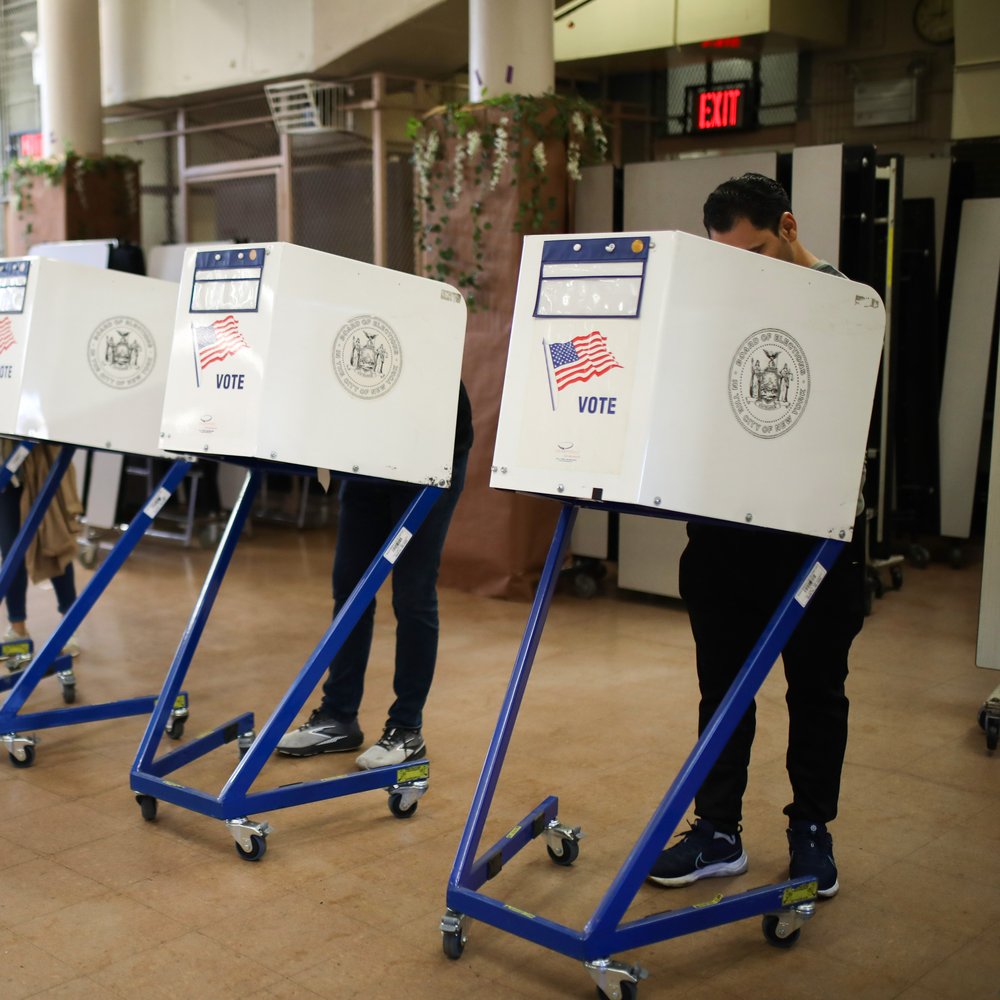
The United States is experiencing one of the fastest episodes of democratic decline seen this century. We charted this in the Power for Democracies’ 2026 report on the State of US Democracy and explained why the 2026 mid-term elections are a high-leverage near-term opportunity to slow the likelihood of US democratic decline.
In its 2026 Democracy Report, the Varieties of Democracy Institute (V-Dem) also found that 'the speed with which American democracy is currently dismantled is unprecedented in modern history.'
On a podcast in February this year, President Trump called for Republicans to "nationalise” the midterms, an activity organised at state rather than federal level. He claims it would prevent what he described as "widespread voter fraud” – a false claim used to rationalise his loss to Joe Biden in the 2020 presidential election, and one he has made 107 times this year alone, according to Reuters.
Just a few days before his podcast interview, the Federal Bureau of Investigation seized local voting records from 2020 in the state of Georgia to search for evidence of the disproven ‘voter fraud’. Homeland Security Secretary Markwayne Mullin refused to rule out deploying the Immigration and Customs Enforcement agency at polling places during his Senate confirmation hearings.
Together, these actions reinforce a years-long disinformation campaign that had convinced most Republicans the 2020 election was illegitimate, putting the peaceful transfer of power in 2026 and beyond at greater risk.
How we mapped the threats to US mid-term elections
To help US-based NGOs and democracy funders direct their resources to where they may have the most potential for impact, we mapped the specific threats facing the 2026 elections and the civil society tactics most likely to counter them.
One key finding from our mapping, and something that should concern all democracy defenders, is that nearly every threat we assessed rated at high or medium severity. This means that each threat has demonstrably affected voter participation or election certification, and pro-democracy efforts have not been able to neutralise their impacts.
The purpose of this exercise and analysis was to quickly identify and prioritise threats to the 2026 elections and promising evidence-based counter-tactics in less than four weeks of staff time. The map is intended to inform donors and practitioners of practical areas of focus over the next five months ahead of the elections in November.
We combined desk research, expert interviews, structured prioritisation, and theory of change analysis. We scanned the work of established US democracy organisations, e.g. Protect Democracy, the Brennan Center, and others, to catalogue the threats they're tracking and the responses they're proposing, continuing until our search hit saturation.
We then collected evidence on each threat's impact on voter turnout or election certification, drawing on US and international cases, and rated severity accordingly. For tactics, we filtered out those already well-funded or unworkable before November, then assessed the rest against expert input (three-of-five endorsement threshold) and theory of change.
Pairing counter-tactics to threats
One anticipated threat is the presence of federal security forces at polling sites, especially in swing districts. In one survey of election experts, 27 out of 37 said that it was at least somewhat likely that the federal government would deploy some form of military or law enforcement to polling places. Correlational studies suggest such a presence can shift turnout by more than a percentage point, and even the perception that forces are present appears to suppress voting.
A promising counter-tactic is to deploy trained poll monitors and election lawyers. Awareness of their presence likely reduces election tampering by political elites and voter fear, and builds trust in the process. According to our back-of-the-envelope estimate, roughly 37,000 votes in high-priority districts could be secured if monitors and lawyers were deployed at scale.
Resources
Below you will find the US threat and tactic map document, and a bibliography for the analysis.
US election integrity threats and tactics map
Our rapid mapping analysis resulted in prioritised threats and their respective counter-tactics. Nearly every threat we assessed rated at high or medium severity
Our sources
The bibliography provides sources for the research that went into the rapid analysis mapping exercise.
Takeaways
- According to our desk research and expert interviews, there are numerous promising counter-tactics that remain underdeveloped ahead of the 2026 elections.
- The severity ratings likely undervalue threats to election certification, which are harder to measure than threats to participation. Even though threat impacts on certification are more difficult to measure, certification is vital to election integrity and deserves due attention.
- There is a dearth of evidence behind most of the tactics we reviewed. To counter similar threats to the 2028 presidential election, donors should prioritise evaluating the impact of 2026 election integrity programmes now.
The US election integrity map research was led by Peter Lang, Research Fellow.