Will democracy survive?
When we founded Power for Democracies in 2023, the world seemed a different place, writes Markus Beeko. Now, our mission to identify solutions and tactics that strengthen democracy is even more urgent.

The question – will democracy survive? – hung on a banner over the stage at an international gathering I recently attended.
The conference brought together policymakers, legal experts, AI researchers and civil society activists, fighting on the front lines of human rights and democracy. In the workshops and panel discussions, the contributions from attendees like the Israeli historian Yuval Harari, the Nobel Peace Laureate Tawakkol Karman or the Belarusian opposition leader Sviatlana Tsikhanouskaya all underscored the threats and challenges facing democracy, peace, and humanity.
When we set up Power for Democracies, the focus on defending democracies was not at the centre of our thoughts. The questions initially driving our small group of researchers, scholars, and activists focused on democratic resilience – on the question of whether democracies were being perceived as delivering or on how democratic innovations could help develop democracies to keep them relevant, responsive, and resilient.
But by the middle of 2024, global developments were sending stark signals. For the first time in two decades, the Varieties of Democracy Institute, or V-Dem, found that autocracies outnumbered democracies, 91 to 88. The number of liberal democracies sat at 29 countries – a level not seen since 2009. Around three in four people in the world lived in some form of autocracy.
Power for Democracies' first analysis of anti-democratic attacks in 147 countries showed that 120 countries across the globe were affected and how sophisticated the variety of the attacks were.
It became evident to us that our starting point should be ‘defending democracy’. Our aim was to identify civil society initiatives effectively countering authoritarian attacks in priority countries – and, importantly, organisations that have funding gaps for initiatives that donors could fill.
The systematic process we developed covers four phases.
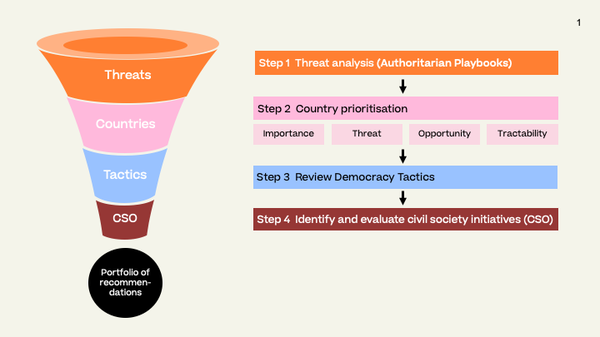
In November 2025, we launched our portfolio with the first donor recommendations covering impressive civil society initiatives in Argentina, Turkey, and the United States, followed recently by Italy. In the coming days we will publish recommendations from Indonesia as well.
Each of these initiatives effectively addresses crucial aspects of defending their respective country's democratic trajectory. By the end of 2026, these recommendations will have channeled approximately €2 million from our network to these initiatives on the ground, supporting strategic litigation, voter mobilisation and legal advocacy.
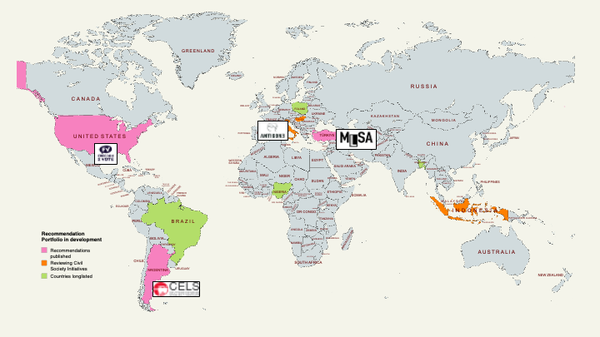
As a small organisation we are agile and able to shift as threats emerge. This year after much deliberation, we will work on two crucial lines of defence for democracy – the increasing authoritarianism in the US and the threats posed by artificial intelligence.
Defending US democracy
While the signs were undeniable – not least the Heritage Foundation’s Project 2025 “‘Mandate for Leadership”’ – it still was breathtaking to watch the authoritarian playbook in action, live and at pace, in the US since January 2025.
“The speed with which American democracy is currently being dismantled is unprecedented in modern history," notes V-Dem’s latest 2026 Democracy Report. It finds that the hardest hit aspect of US democracy are legislative constraints, reaching the lowest point in over 100 years. Other democratic rights such as civil rights and equality, freedom of expression, and press freedoms are at their lowest levels in 60 years.
However, one point of stability for the country, V-Dem notes, is the electoral system. This aligns with Power for Democracies' assessment that election integrity should be an urgent priority in defending US democracy.
Our research team is working intensively with partners to identify particularly relevant and effective ways to counter the various attacks on election integrity in the US.
AI threats to democracy
The challenges posed by emerging technologies in the existing economic and global power structures have been of major concern to me since the days I helped build Amnesty International's programme on Human Rights in the Digital Age.
The rapid pace of AI development, combined with absent regulatory guardrails and the unchecked power of major tech companies, poses structural threats to deliberative democracy. I am therefore very much looking forward to our current project to map and assess these threats, led by my colleague Karoline Helbig, currently also a fellow for tech and democracy at the Carr-Ryan Centre for Human Rights at Harvard University.
Despite the sobering analysis at the recent democracy gathering I attended, and the disturbing numbers and the disappointing responses we see too often in the world, what I experienced in the conference hall was commitment and determination across the room.
A shared spirit commanded action, not despair. Or, as one Belarusian attendee put it more poetically, "As long as there are people ready to die for democracy, democracy will not die".