AI and democracy: mapping the landscape
To understand AI’s potential impact on democracy, Power for Democracies has built a map of AI-derived threats to democracy, the strategies best placed to mitigate them, and opportunities to leverage.
AI has been reshaping how information spreads, how governments operate, and how citizens participate. Deciding where to direct limited resources to protect democracy from these rapid developments has been far from straightforward.
While various research communities have been working in parallel, producing valuable but fragmented analyses, no single resource exists that brings these findings together into a coherent body of work.
The evidence base is fragmented enough that mapping and prioritisation are themselves high-leverage philanthropic work. There is also a considerable lack of prioritisation between democratic threats and their respective counter-strategies.
The AI-democracy landscape tool
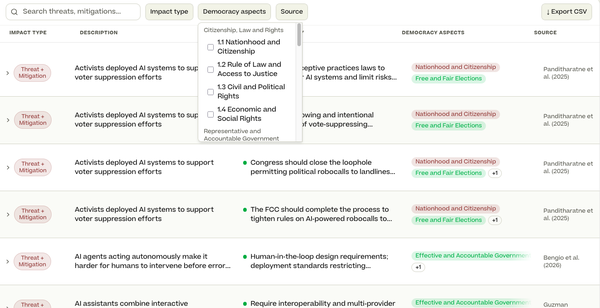
This interactive table allows you to drill down into threats, mitigations, and opportunities
Mapping threats, mitigations and opportunities
Bringing a wide range of sources together provides a comprehensive view of the areas of democracy affected by AI.
What we did
Given how fast AI is developing, we began filling these gaps as a priority. Over six weeks, our team reviewed a wide body of existing literature and selected ten leading frameworks mapping AI threats.
The selected literature spans multiple levels of abstraction, disciplinary lenses, and democratic contexts – from the Carnegie Endowment for International Peace's broad survey of AI and democracy to the Brennan Center for Justice's focus on US electoral integrity, to the global perspective of the 2026 International AI Safety Report.
We extracted and standardised entries from these sources into a unified, publicly available database containing:
- 144 documented AI threats to democracy
- 103 pro-democracy strategies for addressing them
- 44 independent opportunities for strengthening democratic resilience
Each entry is mapped onto the aspects of democracy it affects, using an adapted International IDEA framework of democracy that clusters around: citizenship, law and rights; representative and accountable government; civil society and popular participation; and a category covering international dynamics.
What the map reveals
Bringing these sources together provides a comprehensive view of the areas of democracy affected by AI, allowing patterns to be identified more easily. Here are some of the things we have noticed:
Attention is concentrated on visible threats.
The field favours visible, episodic threats with less attention on structural, compounding threats. The largest cluster of documented threats concerns the information environment, such as deepfakes, disinformation, AI-enabled persuasion at scale. Regulatory responses in this area, such as disclosure requirements and labelling laws, are comparatively well-developed.
The most serious threats may be understudied.
AI risks that can lead to structural consequences, such as the lack of transparency in AI-assisted government decision-making, the concentration of AI power in a handful of technology firms, the gradual erosion of citizens' capacity for independent thought, appear far less frequently in existing literature, and attract correspondingly less attention and funding.
Policy responses to long-term structural threats remain thin.
Similarly, while substantial policy and advocacy work has been generated to counter AI threats to democracy, responses to the long-term democratic effects such as AI power concentration and eroded institutional accountability are notably underdeveloped.
Global transfer is an open question.
The effects of AI on democracy are global, but the discourse and responses are concentrated in limited geographical regions such as the United States and the EU. Almost nowhere in the literature we explored was there serious engagement with how responses developed in one democratic context might apply in another, or with the experience of non-Western countries.
What comes next
This mapping is a first step in a longer journey. We are currently working on clustering threats and pro-democracy strategies for easier navigation and exploration of the map. The pro-democracy strategies are being sorted into strategic approaches to be enacted by different actors, like citizen-led efforts to counter manipulation, different types of legal and accountability frameworks or enacting responsible AI development practices.
While trying the same for the threats, we noticed that they are addressed in considerably more detail in our source texts, and that we could identify some patterns regarding the circumstances around which they tend to occur. So we are currently working on some deeper analysis that helps to reconstruct causal chains leading to downstream effects like cognitive deskilling, concentration of power and chilling effects on participation and draft positive theories of change. These causal chains, in turn, allow us to identify entry points where pro-democracy action can affect the widest range of downstream negative effects. This is a work in progress and we are currently consulting with experts to test the system.
If you are a researcher, funder, or practitioner working in this space and would like to engage with or build on this work, get in touch.